
Youth Concerts
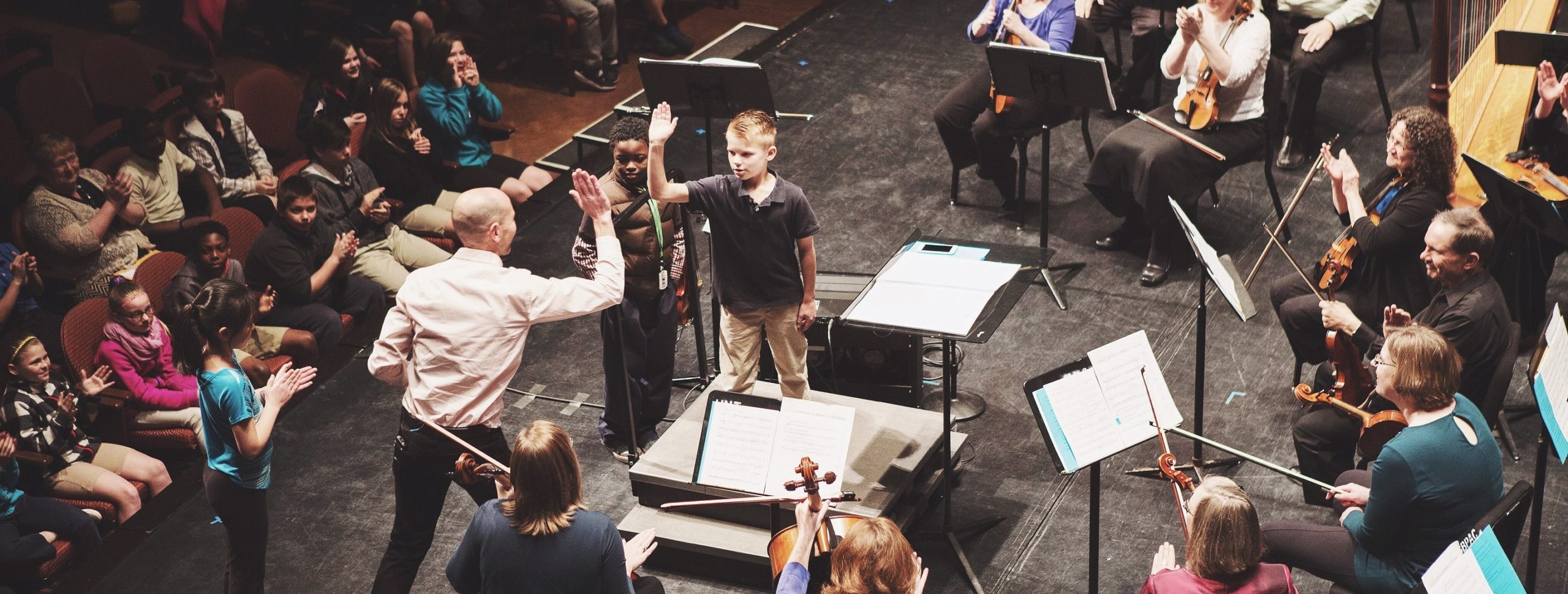
Each spring, our Youth Concerts inspire 4,000 4th-6th graders from schools across an 8-county region. These free performances showcase the full orchestra in engaging, interactive programs designed to captivate young audiences.
The 2026 Youth Concerts will be held in person at the Great Hall of the Gallagher Bluedorn Performing Arts Center on March 31st at 10:00 AM and 12:30 PM.
wcfsymphony Youth Concerts are made possible through generous grants from the R.J. McElroy Trust, Guernsey Charitable Foundation, and Community Foundation of Northeast Iowa, along with support from the wcfsymphony Education Committee and Martha Kroese.
__________________________________________________________________________________________________________________________
2026 YOUTH CONCERT
Dear Educator,
Welcome to the 2026 Waterloo-Cedar Falls Symphony’s Youth Concert at the Gallagher-Bluedorn Performing Arts Center! This year’s wcfsymphony Youth Concerts will take a unique in-depth look at one of the composer’s most important, and frequently misunderstood, pieces – the Fourth Symphony. In addition to learning about the history and musical substance of the Fourth, students will be introduced to broader ideas connected to Tchaikovsky’s work, including an overview of the symphonic tradition and orchestras in general and the world of Russia in the late 19th century.
As we get ready for the concert, let's take a moment to reflect on a couple of important concepts with your students.
The Orchestra:
The orchestra that students will see and hear in April is a product of the 19th century, when a variety of factors including industrial production of wind and brass instruments and an increasing formalization of the conductor’s role encouraged an explosion in the size and diversity of orchestral forces. Tchaikovsky himself was one of the great orchestrators of the Romantic era. Classroom exercises could involve listening for various techniques he used, including massing of homogenous instruments [as in Tracks 1, 7 & 8 below] and combinations of distinct sounds from different sections of the orchestra [as in Tracks 2 & 5 below].
The Symphonic Tradition:
The symphony as a musical genre reached its zenith during the second half of the 19th century. Composers like Brahms, Mahler and Tchaikovsky each made epochal contributions to the form during this period. The Fourth Symphony in particular offers a rich lesson in the possibilities of the four movement symphonic design, combining traditional structure and technique with a quasi-programmatic subtext. Students should learn about the typical four movement symphonic layout as well as the characteristics of each individual movement as observed by 19th-century composers. Other composers who could be referenced with respect to the history of the symphony include Mozart, Haydn, Beethoven, Mendelssohn and Schumann.
The Conductor's Role:
In the past, many orchestras didn’t have a conductor, and the players would follow each other by ear to maintain a steady tempo and musicality. Over time, ensembles began to be led by the concertmaster (usually the first violin) or the keyboard player. In more recent decades, the role of the conductor grew in importance, and today, every modern orchestra has a conductor who leads the ensemble.
The conductor's job is to guide the orchestra through the music, using hand and body movements to keep everyone in sync. Some conductors use a baton (a long stick) to help with this, while others prefer to use just their hands.The conductor uses a printed score, which is like a map of the music with all the parts for each instrument. The score starts with the woodwinds at the top, followed by brass, percussion, and strings at the bottom. The conductor has to read all of these parts at once!
WCF Symphony Conductor: Our conductor, Jason Weinberger, visits different schools across the area throughout the year, providing students with a hands-on experience in conducting a large symphonic ensemble. This engaging and interactive activity offers valuable insight into the art of conducting and is always a favorite among students. For more information about the Conductor's school visit, contact us at office@wcfsymphony.org.
The Composer:
Who was Tchaikovsky?
Tchaikovsky was a famously tormented individual and his dramatic biography offers students a unique window into the life and mind of a great composer. A short unit on Tchaikovsky’s life should touch upon his family history, his training in the law and subsequent decision to pursue music, his tendency toward depression and melancholy, and his difficult relationships with women. Mention of his achievements could emphasize his work in both ballet and opera and his love of Mozart’s music.
Russia in the 19th Century
Our historical vision of 19th-century Russia is easily clouded by the turbulent events of the 20th century, giving the last decades of the tsarist period a dream-like unreality. This world, however, comes to life vividly in the music and biography of Tchaikovsky. Classroom work might focus on issues specific to the composer, including urban and rural musical life in tsarist Russia, issues of social rank, and the geographical circumstances of the Russian privileged classes.
__________________________________________________________________________________________________________________________
Symphony no. 4 (1878)
After completing his Fourth Symphony Tchaikovsky wrote a letter about the piece to his patron Nadezhda von Meck [quoted throughout]. The correspondence is notable for the programmatic insight it provides into the symphony, but there is some debate about Tchaikosvky’s earnestness – he may have presented these ideas to von Meck simply to satisfy her demands for explanation. Quoting Heinrich Heine the composer admitted, ‘Where words leave off, music begins.’ The questions surrounding this letter, and the musical content of the symphony itself, invite students to think about what music ‘means’ and how to find meaning through listening.
1. Movement 1; Andante sostenuto - Moderato con anima:
The Fourth Symphony begins with a series of menacing brass fanfares. Its composer called this dramatic opening ‘the seed of the whole symphony, without doubt the principal idea – this is Fate.’
Movement 1 - Opening
A ‘languishing’ theme then arises in the strings and winds. Tchaikovsky’s gift for evocative melodic writing is apparent in the sighing gestures that appear throughout this theme.
Movement 1 - Allegro Theme
As this theme subsides so does the music’s tormented consciousness, taking refuge instead in a waltz-like ‘daydream’.
Movement 1 - Waltz
Guided listening exercises could encourage students to define the musical and emotional characteristics of each theme/mood and to follow their progress and interaction throughout the movement.
Movement 1 - Full Movement
2. Movement 2; Andantino in modo di canzona:
Nostalgia is a strong element of Tchaikovsky’s music, and the composer claimed that the opening theme of this movement was full of ‘teeming memories… so much has been and gone.’
Movement 2 - Opening
As the movement continues the music seems to vacillate between contentment and sadness, ‘moments of joy… when life was satisfying… hard times, too, irreplaceable losses… both sad yet somehow sweet to immerse yourself in the past.’ Students can be enouraged to listen for the distinct sounds of major and minor as well as specific elements of instrumentation, melody and rhythm that contribute to the shifting moods of the music.
Movement 2 - Complete
3. Movement 3; Scherzo: Pizzicato ostinato - Allegro:
This delightful movement is notable for the way in which each section is clearly defined by a specific instrumental technique, creating the impression of a series of distinct musical ‘pictures’. The first is a bubbling ramble for strings playing pizzicato.
Movement 3 - Opening
After a wind band interlude interrupts the strings, the brass come through with their own lively march.
Movement 3 - March
Tchaikovsky himself considered this a fantastical movement, giving ‘free reign to imagination’ and having ‘nothing in common with reality’. Listening exercises should focus on the delightful contrasts of this movement, and the way in which all the musical elements cascade into one another at the movement’s conclusion.
Movement 3 - Complete
4. Movement 4; Finale: Allegro con fuoco:
The final movement of the Fourth Symphony is one of the most exciting works in the symphonic repertoire, a musical ‘picture of folk celebrating a festival… abandoning themselves entirely to feelings of joy’. Tchaikovsky brings this ‘spectacle’ to life by quoting the melody of a famous Russian folk tune throughout the movement.
Movement 4 - Folk Song Theme
The excitment and joy of the musical festivities build to a massive climax, at which point the ‘Fate’ motive from the beginning of the symphony suddenly returns – ‘barely have you managed to forget yourself and to be carried away by the spectacle of other people’s joys when implacable Fate appears again and reminds you of its existence.’ As students listen to this music they should be encouraged to consider how a single idea or thread runs through the entire work, unifying its abstract musical ideas into a universal portrait of human existence.
Movement 4 - Complete
A fantastic resource for continued exploration of Tchaikovsky’s Fourth Symphony is the SF Symphony’s Keeping Score documentary about and performance of the piece.
Additional Performances
Besides performing Tchaikovsky’s piece, the wcfsymphony will also be performing alongside the winner of the 2026 Young Artists Concerto Competition during the Youth Concert.
The Young Artists Concerto Competition is an annual opportunity for high-achieving music students across Iowa. Students in grades eight through twelve who specialize in piano, strings, woodwinds, brass, or percussion are encouraged annually to participate.
The 2026 Young Artists Concerto Competition will take place on March 1, 2026, in Davis Hall at the Gallagher Bluedorn Performing Arts Center on the University of Northern Iowa campus in Cedar Falls. Stay tuned for the results on our website: https://www.wcfsymphony.org/education/concerto-competition/
_____________________________________________________________________________________________________________
We look forward to seeing you at our upcoming Youth Concerts!